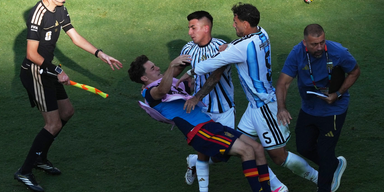


According to reporting from The Athletic, football’s global rule-making body has stated that although the provision was utilised in this way during the World Cup, the "Mistaken Identity" clause must not be applied to judge acts of simulation.
Background and Explanation of the Mistaken Identity Rule
Under the VAR protocol set by the International Football Association Board (IFAB), this clause only applies to confirming the identity of the player who committed an offence when a referee awards a yellow or red card to Player B instead of the offending Player A. It cannot be used to review or alter the nature of the original offence — for instance, it is not permitted to change a decision of “opponent foul” directly into a ruling of “simulation by the attacking player”.
IFAB, the organisation responsible for drafting the Laws of the Game, clarified that the Mistaken Identity rule exists solely to identify which player committed the offence; it cannot be deployed to reassess or revise the type of infringement itself, such as reclassifying an incident as simulation. The body added that the future application of the clause will depend on a comprehensive review of VAR protocols used throughout the World Cup.
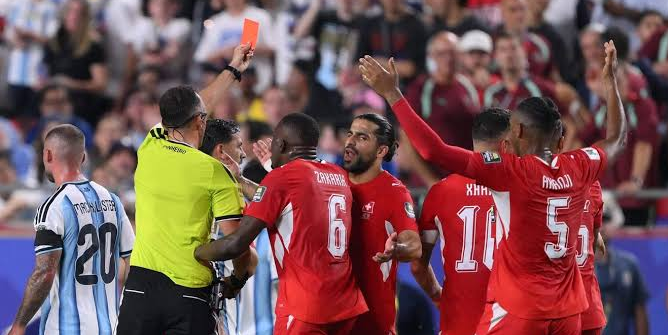
Under this updated guidance, Breel Embolo should never have received a second yellow card and subsequent dismissal during the World Cup quarter-final between Switzerland and Argentina.
A raft of new regulations were introduced for this United States, Canada and Mexico co-hosted World Cup, granting Video Assistant Referees expanded intervention powers, including authority to step in for cases of mistaken identity when yellow or red cards are issued.
Per pre-tournament IFAB guidelines, VAR officials with independent access to match footage may assist the on-field referee when a “clear and obvious error” or “serious missed incident” occurs — specifically when disciplinary punishment is handed to the wrong player.
However, this created confusion over the precise boundaries of the rule, and whether its scope could be extended to cover simulation and enable reclassification of offence types.
The first instance of this contested interpretation arrived in the group stage fixture between the United States and Paraguay. Referee Danny Makkelie initially deemed US defender Tim Ream to have fouled Paraguayan forward Miguel Almirón and showed Ream a yellow card. On the advice of VAR official Carlos del Cerro Grande under the Mistaken Identity framework, the referee reviewed the incident, rescinded the original booking — as Ream had not made contact with Almirón — and instead cautioned Almirón for simulation.

A second, far more controversial application took place in the quarter-final between Argentina and Switzerland. Embolo was initially awarded a free kick, and Argentina’s Leandro Paredes received a yellow card for the challenge. VAR again recommended a review, arguing Paredes had made no contact with Embolo. Following footage inspection, Embolo was judged to have dived to deceive officials, picking up a second yellow card which resulted in his dismissal, while Paredes’ caution was withdrawn.
The decision proved a turning point in the match. Switzerland had equalised to make it 1-1 only five minutes beforehand, and Argentina went on to beat the Swiss 3-1 after extra time.

In a circular issued on Monday, IFAB clarified the VAR protocol for Mistaken Identity, confirming that original offence classifications cannot be overturned — citing the cases of Almirón and Embolo receiving retrospective yellow cards for simulation as examples. The rule may only be invoked when the referee has sanctioned the incorrect player under their initial judgement.
While IFAB acknowledged that this novel use of Mistaken Identity to penalise simulation received positive feedback during the tournament, it issued formal guidance:
“A yellow card which is not a second caution may only be reviewed to identify the player who committed the penalised offence; the offence itself cannot be reviewed or changed.”
“The use of the mistaken identity clause to deal with simulation during the FIFA World Cup 2026 was well received and will form part of the detailed review of the VAR protocol announced in Circular No.32. However, this practice must not be repeated pending the conclusion of that review.”
In both the Almirón and Embolo incidents from the World Cup, the VAR recommendation altered the referee’s original verdict from a “foul” to “simulation”. This constitutes a reassessment of a separate subjective offence, a procedure that requires the on-field referee to conduct an on-field pitchside monitor review.